
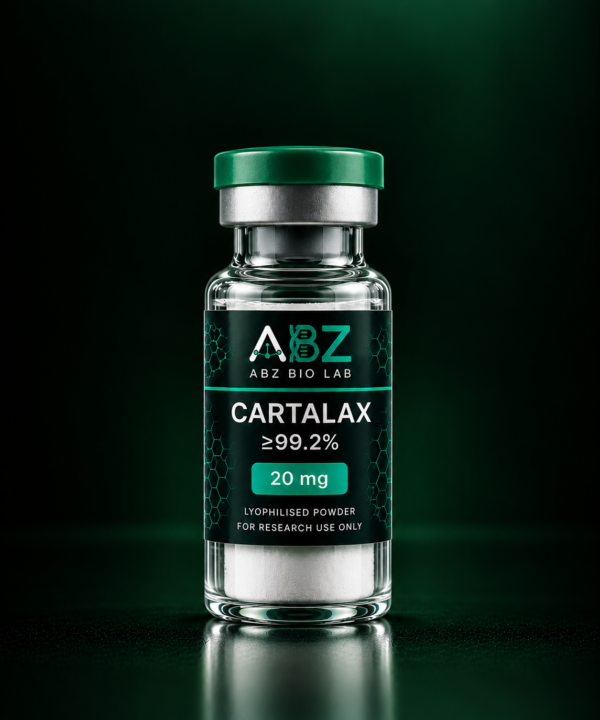
Buy Cartalax Online (5mg / 10mg / 20mg) | Synthetic Cartilage Bioregulator
When connective tissue researchers and biogerontologists seek to buy Cartalax online to investigate joint cellular repair, securing an exact tripeptide sequence without truncated fragments or salt impurities is vital. ABZ Bio Lab supplies analytical-grade Cartalax reference standard (CAS 85806-95-7) variants manufactured to an upgraded purity baseline of ≥99.2% HPLC purity.
Cartalax—also known as the AED peptide or T-31—is a synthetic short-chain peptide bioregulator consisting of three amino acids: L-Alanine, L-Glutamic acid, and L-Aspartic acid ($\text{Ala-Glu-Asp}$). Developed within the framework of short-peptide bioregulator research, Cartalax penetrates cell membranes to interact directly with nucleosomal chromatin. In primary chondrocyte cultures and mesenchymal stem cell models, it modulates gene transcription to favor the expression of structural extracellular matrix proteins, including Type II collagen, aggrecan, and SOX9.
Every batch produced by ABZ Bio Lab undergoes automated Solid-Phase Peptide Synthesis (SPPS) followed by multi-stage cold-chain purification, ensuring complete solubility and zero baseline interference during high-sensitivity cell viability and gene expression assays.
In Vitro Research Applications of Cartalax (AED)
Cartalax serves as a specialized reference compound across orthopaedic, longevity, and tissue engineering research:
Chondrocyte Differentiation & Extracellular Matrix Synthesis
In isolated human and mammalian cartilage cell lines, Cartalax is introduced to evaluate the upregulation of collagen type II ($\text{COL2A1}$), SOX9, and aggrecan ($\text{ACAN}$) genes, measuring structural protein deposition rates in degraded cartilage matrix models.
Mesenchymal Stem Cell & Cell Aging Models
Researchers utilize Cartalax to observe transcriptional changes in human mesenchymal stem cells undergoing replicative senescence. These models assist in evaluating how short peptide sequences influence cellular maintenance markers over extended culture periods.
Molecular Distinction: Cartalax vs. Epithalon vs. GHK-Cu
Understanding sequence topography prevents experimental distortion during comparative testing:
-
Cartalax ($\text{Ala-Glu-Asp}$): A 3-amino-acid tripeptide focused on connective tissue and cartilage matrix models.
-
Epithalon Reference Standard: A 4-amino-acid tetrapeptide ($\text{Ala-Glu-Asp-Gly}$) incorporating an additional glycine residue, evaluated in telomerase induction assays.
-
GHK-Cu Copper Tripeptide: A copper-bound peptide complex ($\text{Gly-His-Lys}\cdot\text{Cu}$) targeting general skin and extracellular tissue remodeling.
Quality Control: Batch HPLC & Mass Spectrometry Verification
Comparing the Cartalax price across suppliers highlights the necessity of analytical transparency over unverified purity claims. ABZ Bio Lab validates every production lot through rigorous multi-spectrum assays:
================================================================================
                    ANALYTICAL TESTING BENCHMARKS
================================================================================
 Quality Metric         Testing Methodology         Pass Benchmark
--------------------------------------------------------------------------------
 Chemical Purity         RP-HPLC Peak Area Analysis ≥ 99.2% Main Peak
 Mass Identification    LC-MS Electrospray          333.29 Da (± 0.5 Da)
 Peptide Content         Elemental Nitrogen Assay   ≥ 85.0% Net Content
 Endotoxin Load         LAL Chromogenic Assay       < 0.25 EU/mg
 Residual Moisture       Karl Fischer Titration     < 3.0% Residual Moisture
================================================================================
A batch-specific Certificate of Analysis (COA) displaying complete HPLC chromatograms and mass spectra is included with every shipment or downloadable digitally prior to purchase.
Technical Specification Matrix
| Structural & Analytical Parameter | Laboratory Standard |
| Product Name | Cartalax Reference Standard |
| Synonyms & Codes | AED, Ala-Glu-Asp, T-31 Peptide, Cartilage Bioregulator |
| CAS Registry Number | 85806-95-7 |
| PubChem CID | 87815447 |
| Chemical Sequence | $\text{H-Ala-Glu-Asp-OH}$ |
| Molecular Mass | $333.29\text{ g/mol}$ |
| Chemical Purity | ≥99.2% (RP-HPLC Peak Area Ratio) |
| Physical Appearance | White to off-white lyophilized powder / cake |
| Salt Format | Acetate salt format |
| Solubility Profile | Soluble in aqueous buffer media, Bacteriostatic Water, or 0.1% acetic acid |
| Batch QC Documentation | HPLC Chromatogram & LC-MS Identity Spectrum |
Handling, Reconstitution & Storage Directives
To preserve peptide stability and prevent physical breakdown during benchwork:
-
Unopened Lyophilized Storage: Store dry vials sealed at -20°C for extended shelf-life (up to 24 months). Short-term bench storage at 2°C to 8°C is suitable during active testing. Protect from direct ambient light.
-
Reconstitution Protocol: Allow the vial to equalize to ambient room temperature before adding solvent to avoid condensation. Slowly introduce sterile laboratory Bacteriostatic Water down the inner glass wall. For rapid dissolution, a minimal volume of 0.6% Acetic Acid Solution can be utilized prior to buffer dilution. Swirl gently until the cake completely dissolves—do not agitate or shake violently.
-
Reconstituted Solution Stability: Keep dissolved liquid refrigerated at 2°C to 8°C and complete testing protocols within 21 to 28 days.
Direct Warehouse Procurement & Fulfillment
ABZ Bio Lab provides a streamlined procurement system tailored for research institutes, universities, and commercial laboratories:
-
Direct Central Supply: Dispatched directly from central UK and European distribution hubs to avoid customs holds and international transit risks.
-
Thermal Shock Packaging: Vials are packed inside shock-absorbing, thermally buffered outer cartons to preserve stability throughout transit.
-
Direct BACS Transfer: Place purchase orders online or request pro-forma invoicing for direct bank transfer payments.

Reviews
There are no reviews yet.